




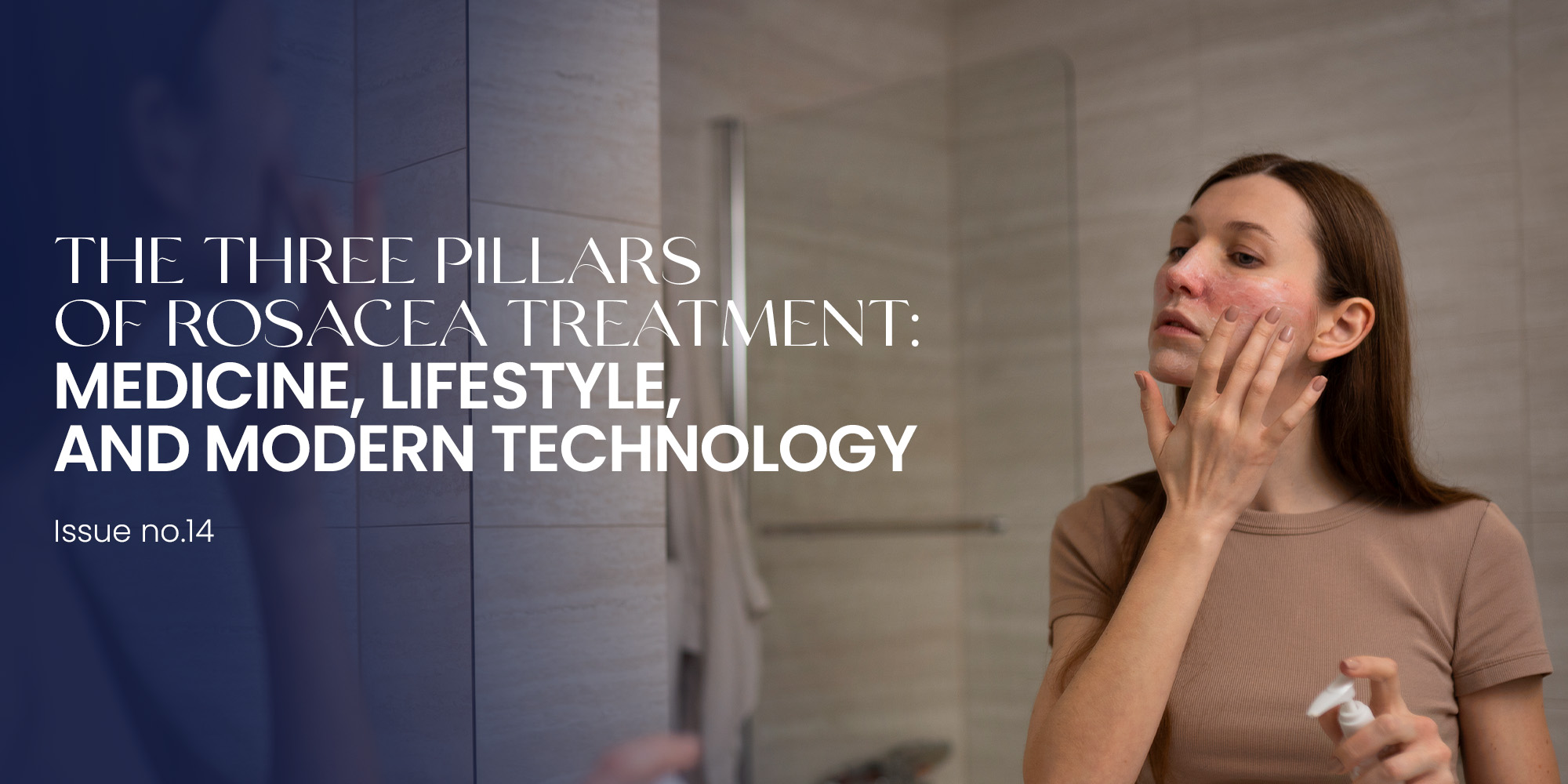
It starts with a flush (a sudden redness flare – overactive blush) that won’t go away. Then come the tiny, spider-like veins across the nose and cheeks. Before long, your complexion feels perpetually inflamed, burned, and sensitive.
If this sounds familiar, you’re not just dealing with “sensitive skin”. You are likely part of the estimated 415 million people worldwide living with rosacea.
Rosacea is not a surface issue. It is a skin inflammation condition, vascular instability, and impaired skin barrier function. Untreated redness often worsens over time. Facial flushing, burning, heightened skin sensitivity, and fine visible vessels (telangiectasia) can progress if not treated correctly.
Rosacea doesn’t respond to one-size-fits-all solutions. Effective treatment requires a layered medical approach: calming inflammation, controlling triggers, addressing abnormal blood vessels, and choosing technologies that respect already-reactive skin.
In our practice, we see this every day, the emotional weight of it: the frustration and embarrassment. Patients often arrive after trying cosmetic solutions that temporarily mask redness. That doesn’t work. Medical problems need medical solutions. Our approach to rosacea is strictly medical first.
Below, we outline the most effective, evidence-based strategies we use today to treat rosacea and fine facial vessels—what works, why it works, and when advanced medical interventions become necessary for long-term control.
Topical therapy remains the foundation of rosacea management, particularly for controlling inflammation, bumps, and background redness. Among prescription options, several treatments consistently stand out in both clinical practice and published studies:
I – Ivermectin (Soolantra®) – Targets inflammation and Demodex mites, which are present in higher densities in rosacea-prone skin.
Up to 75% reduction in inflammatory lesions after 12–16 weeks
II- Brimonidine (Mirvaso®) – Vasoconstrictor, temporarily narrowing superficial facial blood vessels responsible for persistent redness.
Results within 30 minutes, lasting up to 12 hours
III- Azelaic acid (15–20%) – Exerts anti-inflammatory and keratolytic effects, helping reduce papules, pustules, and improving skin texture
50–70% lesion reduction within 8–12 weeks
IV- Metronidazole (0.75–1%) – One of the most established rosacea treatments, working primarily through anti-inflammatory mechanisms rather than antibiotic action. Ideal for long-term maintenance
Proven to reduce flare frequency and relapse
V- Oxymetazoline (Rhofade®) – Another vasoconstrictive agent, with a slightly different receptor profile that provides more sustained redness control for some patients.
Longer-lasting redness reduction
Effective for 12–16 hours with lower rebound risk when correctly prescribed.
VI – Encapsulated benzoyl peroxide (Epsolay®) – A newer-generation formulation designed to deliver benzoyl peroxide gradually, minimizing irritation while targeting inflammatory lesions.
Significant improvement by week 12 with better tolerability
Please pause here for a moment. These treatments are not products you can safely “try and see” on your own. Using the wrong medication or the wrong combination can actually worsen redness, trigger flares, or cause rebound symptoms. Rosacea looks different in every patient, which is why a proper medical assessment and clear diagnosis are essential before anything is prescribed. Only after understanding your specific rosacea pattern can the right treatment be selected safely, effectively, and for long-term control.
Large patient surveys from the National Rosacea Society show that more than 80% of people with rosacea report at least one identifiable trigger that worsens their symptoms:
These findings are echoed in dermatology research published in the Journal of the American Academy of Dermatology, which highlights the strong connection between environmental, dietary, and emotional triggers and rosacea flares. European expert consensus guidelines further reinforce this approach, emphasizing that recognizing and individually managing triggers is a key component of long-term rosacea control.
Long-term control doesn’t mean restriction; These measures can help reduce flare-ups and support skin stability, but they are not a substitute for medical treatment. Rosacea requires properly prescribed therapy to control inflammation and achieve long-term improvement.
Persistent redness and fine facial vessels often require energy-based treatments:
Clinical data shows:
This is where rosacea treatment shifts from control to true visible correction.
Medical aesthetics is evolving—and so is rosacea care. Some newer approaches are being explored:
Has a strong local anti-inflammatory effect besides their skin rejuvenation effects. It can be used fo rosacea as 2-3 treatment sessions 2-4 weeks apart.
These treatments are not first-line options and require expert case selection, ethical practice, and clear patient history education.
Rosacea doesn’t improve with viral trends or random treatments. It improves with:
Understanding the three pillars is the first step. Implementing your personalized combination is the next step.
If redness or flushing is affecting your daily life, book a consultation at Dr. Georges Ziade Clinics for a medical evaluation and personalized rosacea management plan.
New year, new achievements. Here is what we’ve been up to so far:
Dr. Georges Fidawi hosted the RRS Open Day in Dubai, welcoming patients for an exclusive experience. Attendees benefited from consultations and were introduced to RRS sample products, allowing them to better understand advanced skin rejuvenation protocols. Dr. Fidawi is a big believer that the best results happen when you keep patients in the loop so they truly understand their skin and have access to the smartest science out there.
Relfydess Launch by Galderma
Dr. Georges Ziade and Dr. Georges Fidawi attended the official launch of Relfydess by Galderma, a new-generation botulinum toxin distinguished by its rapid onset of action. The event gathered expert leaders and specialists to explore how this new treatment could help their patients. It’s a reflection of their proactive approach: constantly learning to ensure they’re offering the most advanced, effective care possible to their patients.
Introduction of DPL Technology – Dubai
A new Dynamic Pulsed Light (DPL) device was officially introduced in our Dubai Clinic, designed to effectively target rosacea, small vessels, and overall skin quality. This technology offers enhanced precision and improved patient outcomes. The introduction of DPL reflects our commitment to ensuring our patients always have access to the most precise, comfortable, and advanced light-based therapies in aesthetic dermatology today.
Signature Gift Box – Record-Breaking Season
Our Signature Gift Box achieved record-breaking sales across Lebanon and Dubai during the Christmas season, becoming one of the most considered aesthetic gifts of the year. Designed to combine luxury with efficacy, the box resonated strongly with patients seeking meaningful skincare experiences. This newly achieved milestone highlights the growing trust and loyalty of our community across both regions.
Be the first one to be updated, Subscribe to our newsletters and get Advice, Tips, News & Updates delivered straight into your inbox.

Website by


 Beirut
 Dubai
Dubai